 The
The There is a number, somewhere, at which a house stops being real estate and becomes a hypothesis. The compound at 11201 Chalon Road, perched on an eight-acre promontory above Bel-Air, has quietly located that number. At $400 million, it is now the most expensive home ever publicly listed in the United States, and its asking price is less a valuation than a dare aimed at a buyer pool that may not exist.
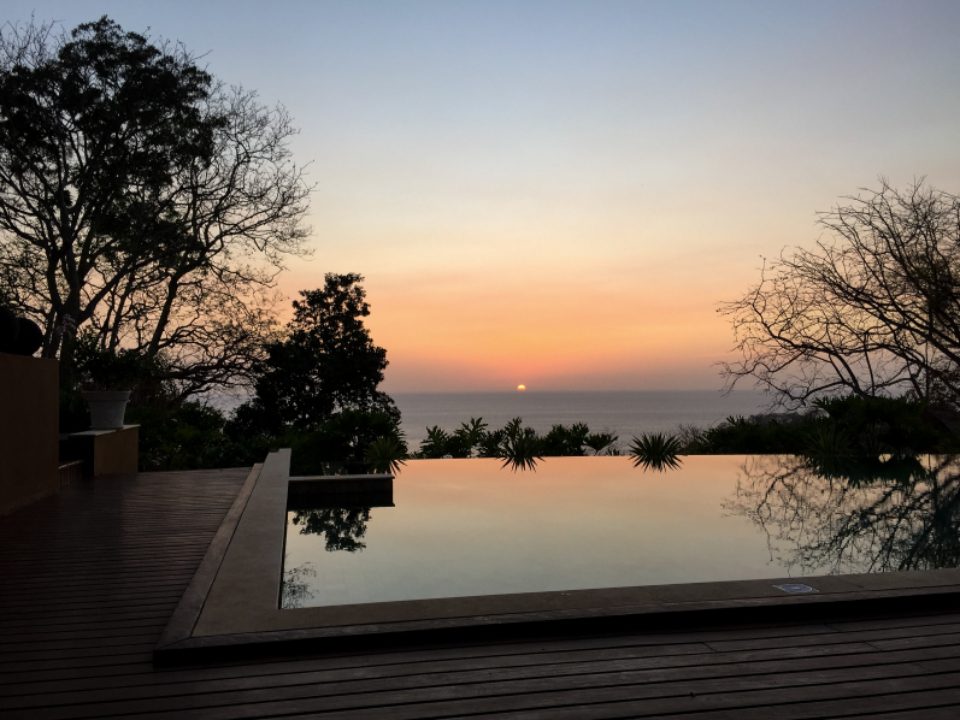
The provenance explains the ambition. The estate is tied to Qatar's ruling Al-Thani family, whose global property appetite has long run from Belgravia townhouses to Manhattan towers. Here, as Forbes reported, the owners poured north of $350 million into a decade-long build, finished it in 2018, and then did the thing that separates a residence from an asset: they lived in it for the better part of eight years before deciding to sell.
The Scale Is the Point
The figures read like a small municipality. Roughly 70,000 square feet spread across a main house and a guest structure that would itself be a landmark almost anywhere else. Thirty-nine bedrooms. Fifty-nine bathrooms. A driveway that runs some 1,500 feet before the architecture even announces itself. Three pools, a dedicated spa wing with sauna and massage suites, a salon, a gym trimmed in hand-stitched leather, a tennis pavilion, and, in a detail that tells you exactly who this is built for, an on-site X-ray machine, art storage, and safe rooms.
None of this is decoration. It is a specification sheet for a buyer who intends to live at a remove from the ordinary friction of the world, with 360-degree views doing the work that gates and distance once did. The property does not compete with other houses so much as with the idea of ever needing to leave one.
At this altitude the market is not a market. It is a list of names, and most of them already own something like it.
Doubling a Record That Barely Cleared
To grasp the audacity, recall the benchmark. In 2019 Ken Griffin paid around $240 million for a Manhattan penthouse, a figure that still stands as the U.S. residential sales record and that itself required one of the wealthiest men in finance to transact. The Chalon asking price is nearly double that. It also dwarfs the cautionary tale hovering over every Los Angeles megamansion: "The One," the Bel-Air spec palace that dreamed of $500 million, entered bankruptcy and sold at auction in March 2022 for $126 million (roughly $141 million including the buyer's premium) to Fashion Nova CEO Richard Saghian, a fraction of its fantasy.
That gap between ask and outcome is the whole story at the top of this market. Listing agents Jack Harris and Michael Fahimian of The Beverly Hills Estates are not pricing to a comparable sale, because none exists. They are pricing to scarcity and to patience, betting that a sovereign-scale buyer will eventually surface for whom a nine-figure discount is simply the cost of the best seat on the ridge. Trophies at this level often trade at 40 or 50 cents on the dollar, and years can pass before the right check arrives.
Who Actually Buys This
The honest answer is: almost no one. The credible field narrows to a few dozen individuals and a handful of Gulf and Asian family offices whose liquidity and privacy needs align with what a fortified promontory offers. For that buyer, the price is not the obstacle. Being invited to consider it is.
Which is the quiet lesson beneath the headline number. A $400 million house does not sell through an open house or a portal listing; it moves through proximity, through the small circle of advisers, agents, and peers who know the property is available before the press does. At the very top, the asset that matters most is not the eight acres above Bel-Air. It is standing in the room where its next owner is decided.
The room is the whole point.
The 1% is the private, verified network behind The 1% Journal — where members reach the people who actually move capital. Membership from $999.